 Twitter
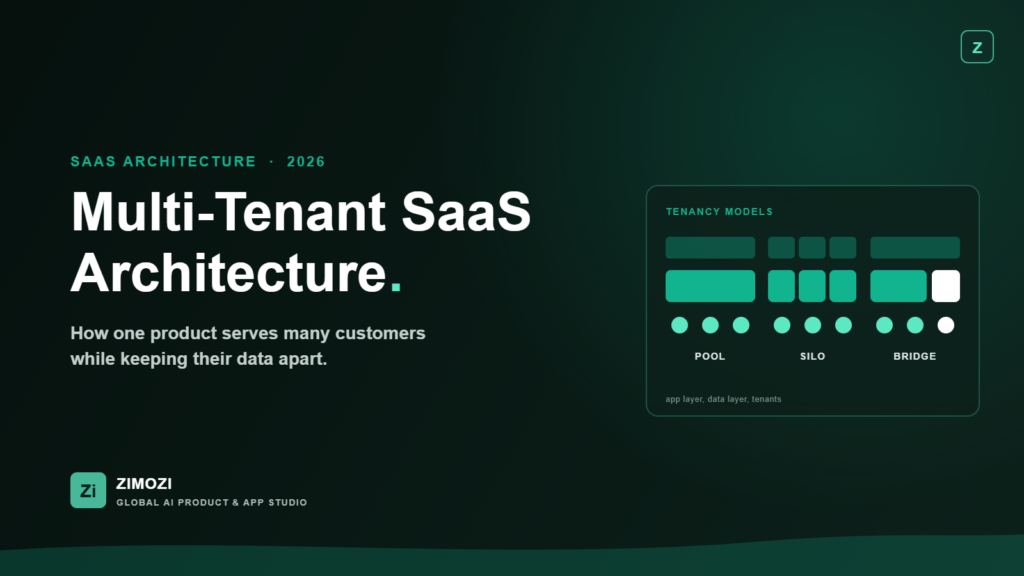
Multi-tenant SaaS architecture is a way of building software where one application serves many customer organisations, called tenants, while each tenant’s data, users and settings stay separate. Customers share the code and often the infrastructure. They never share access to each other’s information.
Done well, it keeps hosting costs sensible, lets you release one update to every customer at once and gives you a clear answer when a larger client asks how their data is protected. For startups and SMEs building SaaS products in Australia, Singapore and the US, it is also one of the earliest technical decisions and one of the hardest to reverse later.
Why multi-tenant SaaS architecture gets harder as you grow
Most tenancy problems show up in ordinary moments:
- A developer adds a new report and forgets the tenant filter on one query
- One customer runs a large import and every other customer’s dashboard slows down
- A new enterprise client sends a security questionnaire asking where their data is stored and who can see it
- A customer leaves and asks for a full export of their data, and only their data
If the product was built for one customer and made multi-tenant later, each of these turns into a project. If tenancy was part of the design from the start, most of them are routine.
What a well-designed multi-tenant setup actually does
Whichever model you choose, a solid multi-tenant SaaS architecture should:
- Identify the tenant from the user’s login or token, never from a value the user can edit
- Tag every record, file and cache entry with the tenant it belongs to
- Enforce separation in the database as well as in the application code
- Stop one tenant’s heavy usage from slowing down everyone else
- Let you onboard, export or move a single tenant without touching the others
Most of this is invisible to customers, which is how it should be. Good monitoring and deployment automation make it much easier to maintain, and this is where DevOps and automation work pays off. If you are adding AI features, the same rules apply to agents and search. Our guide to multi-agent workflows in enterprise SaaS covers that side.
The 3 multi-tenant SaaS architecture models
The AWS Well-Architected SaaS Lens groups the common approaches into three models: pool, silo and bridge. Microsoft’s guidance on tenancy models adds a useful point: isolation is a spectrum rather than a yes or no choice.
Pool model: shared resources
All tenants share the same application and the same database. Each row carries a tenant ID and every query filters by it. This is the most cost-efficient form of multi-tenant SaaS architecture and the simplest to run, because there is one deployment to update and monitor. The trade-off is that isolation depends on your code and database rules, and a very busy tenant can affect the others. This is often called the noisy neighbour problem.
Silo model: dedicated resources
Each tenant gets its own database, or even its own full stack. Isolation is strong and strict client requirements are easier to meet. It also costs more, and every new tenant adds databases to migrate, back up and monitor. As AWS notes, silo tenants usually still share onboarding, identity and management, so it remains one product.
Bridge model: a mix of both
Different tenants or components use different approaches. Most customers might share a pooled database while one large client gets its own. This is flexible, but your code has to support both patterns and you need a reliable way to move a tenant from one to the other.
An example: a booking platform for clinics
Take an illustrative case. A startup builds booking software for physiotherapy clinics and launches on the pool model: one PostgreSQL database, a tenant ID on every table and automated tests that check one clinic cannot see another’s appointments. A year later, a healthcare group signs up and its security review asks for a separate database. Because every record already carries a tenant ID, the team moves that one customer to a dedicated database and leaves everyone else where they are. The product has moved from pool to bridge without a rebuild.
Why tenant isolation breaks in production
In a multi-tenant SaaS architecture, isolation rarely fails because of the model itself. It usually fails in the details. Products that hold up tend to share a few habits:
- Database rules as a second line of defence. In PostgreSQL, row-level security can restrict rows to the current tenant. Table owners and superusers bypass these policies by default, so the application should connect with a role that is actually subject to them.
- Tenant scoping beyond the database, including file storage paths, cache keys, search indexes, background jobs and logs
- Automated tests where a user from tenant A tries to read or change tenant B’s records
- Rate limits, usage limits and metrics per tenant
- A tested process for restoring or exporting a single tenant’s data
Skip these and the architecture looks fine until the first security review or the first large customer. Build them in early and they become part of normal development.
A realistic first step
You do not need to design your multi-tenant SaaS architecture for every future customer on day one. Start with a few questions: who your customers are, what security questions they will ask, how many tenants you expect in the first year and how much operational work your team can handle.
In our view, many early-stage products do well with a pool model, strong isolation built in and a clear path to move specific tenants to dedicated resources later. Products sold mainly to heavily regulated organisations may need to start closer to the silo model.
Either way, keep the first release small and clearly defined, which is the same approach we take in MVP development. If you are on the buying side instead, our article on choosing a SaaS application for your business covers what to look for.
Frequently Asked Questions
What is multi-tenant SaaS architecture?
It is a way of building software where one application serves many customer organisations, called tenants. They share the code and often the infrastructure, but each tenant’s data and settings are kept separate.
What is the difference between single-tenant and multi-tenant SaaS?
Single-tenant SaaS gives each customer a dedicated copy of the application and database. Multi-tenant SaaS runs customers on a shared application. Single-tenant offers stronger isolation at a higher cost, while multi-tenant is more efficient to run and update.
Which multi-tenant SaaS architecture model should a startup choose?
Many start with the pool model and strong isolation, then move selected tenants to dedicated resources when needed. Products built for heavily regulated customers may justify starting with the silo model.
How does Zimozi help?
Zimozi builds SaaS products for startups and SMEs in Australia, Singapore and the US. We help choose a tenancy model, design tenant isolation and plan a manageable first release. Where stricter requirements apply, our cyber security team can review how tenant data is protected.
Where Zimozi fits in
Multi-tenant SaaS architecture comes down to deciding what your customers share and how firmly you keep them apart. We help founders and product teams make that decision early, build tenant awareness into the data model from the first release and keep the option of dedicated resources open for later.
If you are planning a SaaS product, Zimozi can help define a small first version and assess the technical requirements. Would you like to talk through your idea?