 Twitter
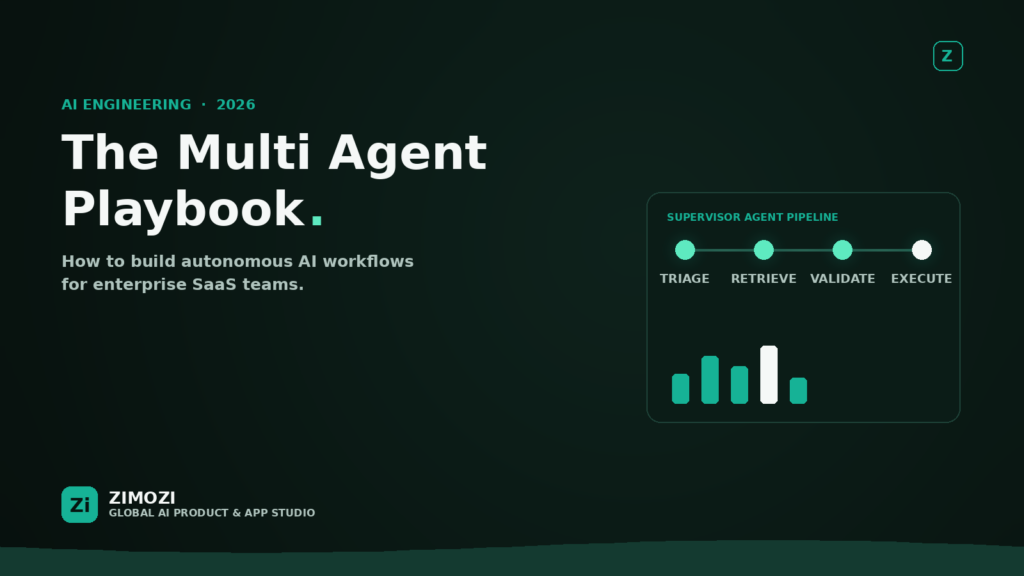
Many software teams have already added generative AI features to their products. In most cases, these features look like search assistants or chat sidebars. They help users write a draft or summarize a document, but they stop short of completing work that spans multiple steps, which is exactly the gap multi agent workflows are built to close.
When an enterprise workflow involves reading data from one system, verifying rules in another, and updating a record in a third, a single prompt is rarely enough. The model either loses context, makes an assumption, or stops halfway through the task.
This is where multi agent workflows become useful. By dividing complex processes into small, specialized steps handled by coordinated agents, software teams can build reliable automations that handle real business tasks.
Moving From Single Prompts to Coordinated Agents
In a standard setup, a user sends a prompt to a large language model, and the model returns text. The interaction starts and ends in one turn.
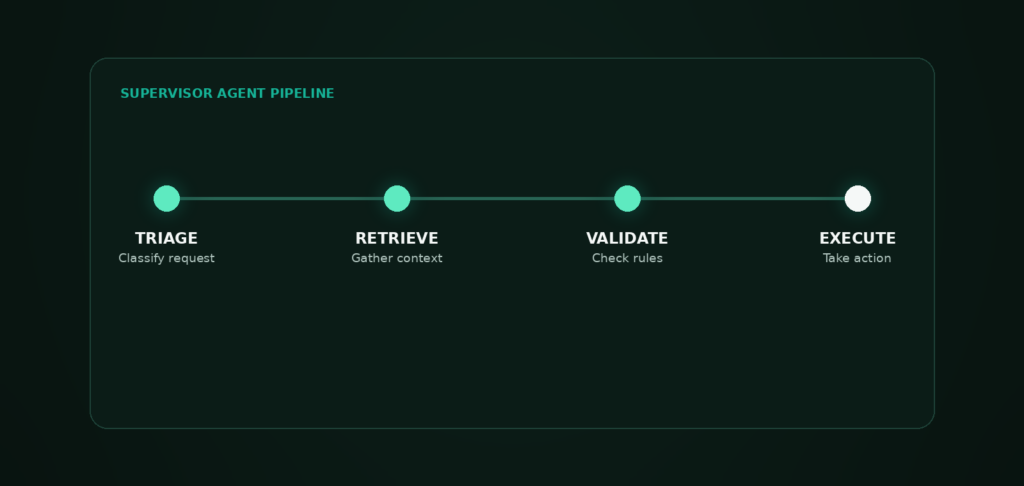
Multi agent workflows operate differently. Instead of relying on one large model to do everything, the application uses a supervisor AI that coordinates a pipeline of specialized agents. Each agent has a clear role, a defined set of tools, and concrete boundaries:
- A triage agent reads incoming information, classifies the request, and determines which process to start.
- A RAG and knowledge agent queries internal documents or an external API to gather verified context with citations rather than guesses.
- A validation agent checks the gathered information against company rules, permissions, or compliance policies.
- An execution agent formats the final result, updates the database, or prepares an action for user approval.
Because each agent handles only one part of the problem, the prompts stay short and specific. This reduces errors, makes debugging easier, and prevents the model from getting confused by conflicting instructions.
A Practical Example: Customer Onboarding in B2B SaaS
Consider a B2B SaaS platform that helps companies manage commercial equipment leases. When a new customer signs up, onboarding requires several steps:
- Verifying company registration details against an external database.
- Checking credit thresholds and existing vendor records in an internal database.
- Generating a custom lease agreement based on the equipment type and jurisdiction.
- Sending the completed package to an account manager for final review.
With a single prompt, trying to handle all four steps at once frequently causes mistakes. The model might generate a valid document but overlook a credit limit rule.
In a multi agent system, the steps are decoupled. Agent A calls the registry API and extracts the verified business number. Agent B takes that verified number, queries the database, and returns the credit history. Agent C evaluates the credit tier against the lease terms. Only after all three steps succeed does Agent D generate the draft agreement and flag it for human review.
The workflow remains predictable because every step produces structured data that the software can inspect before moving to the next stage. This kind of coordination is what makes multi agent workflows reliable enough for production use.
Latency, Cost, and Safety Considerations
Building multi agent workflows requires careful planning around technical limits. Teams planning custom software development with AI agents should evaluate three main factors.
Response Time
Chaining multiple language model calls takes time. If four agents run one after another, a user might wait fifteen to twenty seconds for a result. Where possible, independent tasks should run in parallel. For time sensitive tasks, background queue processing with progress indicators is usually better than a blocking loading screen.
Token Usage and Operating Cost
Every agent call consumes tokens. Without caching and clear stopping conditions, agent loops can run repeatedly and drive up costs. Using smaller, specialized models for classification and reserving large models for complex drafting helps keep operational expenses predictable.
Guardrails and Evaluations
Autonomous workflows should not have unrestricted permission to modify production data. Critical actions, such as sending emails to customers, transferring funds, or changing account access, should always stop and request human approval. Setting up evaluation datasets and safety guardrails ensures that agents behave consistently before they interact with real users.
How to Begin
The most common mistake teams make with generative AI is trying to automate an entire business department on the first attempt.
A better approach to multi agent workflows is to identify one rule based, repetitive workflow where employees currently spend thirty minutes copying and verifying data between systems. Build a small system with two or three coordinated agents to handle that specific task. Measure the error rate, refine the fallback rules, and ensure that the team trusts the output before expanding the system to other features.
Zimozi designs, builds, and ships multi agent workflows, RAG assistants, and workflow automations for fintech, healthtech, and product teams worldwide. Our engineers work with frameworks such as the OpenAI Agents SDK and modern orchestration tools, building real world applications such as Pitch Fabrice, an interview and debrief voice agent, and ResoX AIDA, a dispute resolution assistant for legal workflows. We deliver each project through a clear, fixed scope plan with weekly working demos.
If you are evaluating whether an autonomous workflow makes sense for your SaaS product, we can help review the architecture and outline a practical first phase. Would you like to discuss your use case?