 Twitter
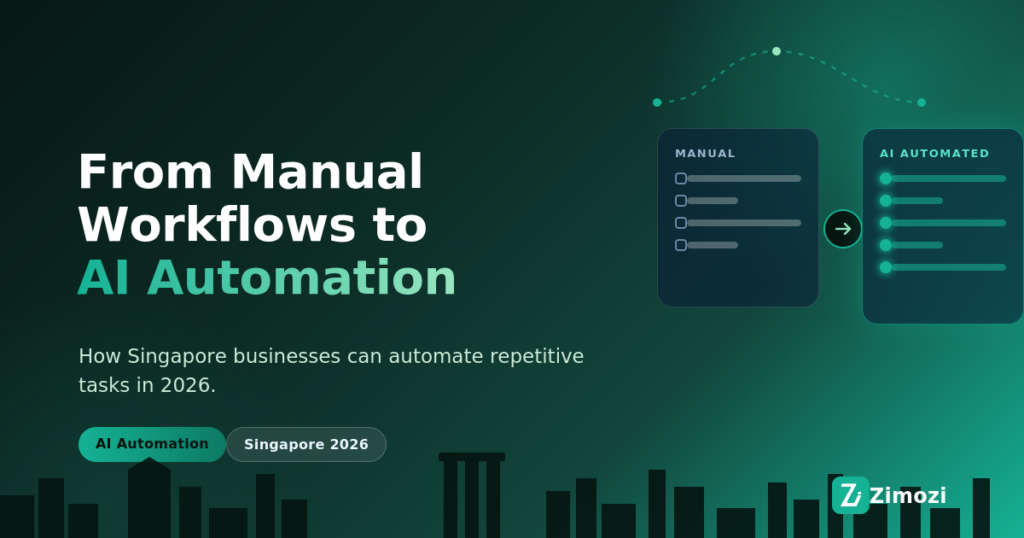
AI automation Singapore businesses are adopting in 2026 is helping many replace slow, manual tasks with systems that run quietly in the background. Entering data into spreadsheets, chasing approvals over email, generating reports by hand, or manually matching invoices to payments: these tasks are not complicated, but they take time, and they pull people away from work that actually needs judgement and creativity.
This is part of a broader shift toward AI automation Singapore companies of all sizes are now able to access, not just large enterprises. The tools have matured, and companies no longer need a large technical team to get started. This article looks at what that shift looks like in practice, and how a business might approach AI automation in Singapore.
Why repetitive tasks are worth automating
Repetitive tasks share a few common traits. They follow a clear set of rules, they happen often, and they do not require much independent decision making. Examples include:
- Copying data from one system into another
- Sending routine follow-up emails or reminders
- Reconciling invoices or payments
- Compiling weekly or monthly reports
- Responding to common customer queries
These tasks are well suited to automation because the rules are predictable. When a task follows a clear pattern, a system can be built to handle it consistently, without needing constant human input.
This does not mean every task should be automated. Work that involves judgement, negotiation, or handling unusual situations still benefits from a person’s attention. The goal of AI automation is not to remove people from the process, but to free up their time for the parts of the job that actually need them.
What AI automation Singapore businesses are adopting looks like in 2026
Automation itself is not new. Businesses have used rule-based tools and scripts for years to handle scheduled tasks or simple data transfers. What has changed is the range of tasks that can now be automated, and how these systems are built.
According to IMDA’s Digital Economy report, Singapore has continued to position itself as a regional hub for enterprise technology adoption, which has made AI tools more visible to small and mid-sized businesses rather than just large enterprises.
AI agents can now handle tasks that used to require more manual judgement, such as reading an incoming email and deciding which department it belongs to, or extracting specific details from a document that does not follow a fixed template. This means automation is no longer limited to strictly rule-based work. It can now support tasks that involve some interpretation, as long as the boundaries of the task are clearly defined.
At the same time, integration between different software systems has become easier, which is a big part of why AI automation Singapore teams are exploring now feels more achievable than it did a few years ago. Many businesses use a mix of tools for accounting, customer management, communication, and operations. Connecting these systems so that information flows between them automatically used to require significant custom development. That is still true for complex integrations, but simpler connections are now faster and more affordable to set up.
A practical example of AI automation Singapore businesses can relate to
Consider a business that processes supplier invoices. Right now, someone might receive an invoice by email, check it against a purchase order, enter the details into an accounting system, and then follow up if something does not match.
An automated version of this process could work like this: incoming invoices are read automatically, key details such as the amount, supplier, and invoice number are extracted, and the system checks these against existing purchase orders. If everything matches, the invoice is logged and queued for payment. If something does not match, it is flagged for a person to review.
This does not remove the need for human oversight. Someone still checks flagged invoices and makes the final payment decision. What changes is that routine, matching invoices no longer require someone to manually type in details or cross-check figures by hand.
How to start with AI automation in Singapore
Businesses that automate successfully usually start with one clearly defined task, rather than trying to automate an entire department at once. A good starting point has three qualities:
It happens often. A task that occurs daily or weekly is worth more effort than one that happens twice a year.
It follows a clear process. If the steps are hard to describe, it will be hard to automate reliably.
It has a measurable outcome. This makes it easier to check whether the automation is actually working as intended.
Once one process is automated and running reliably, it becomes easier to identify the next candidate. This step by step approach also reduces risk, since any issues are contained to a single process rather than spread across the business.
There are also practical considerations to think through before building anything: who owns the data involved, what happens if the automated system makes an error, how the system will be maintained over time, and what level of access it needs to existing tools. These questions matter more than they might seem at first, especially for processes that touch financial or customer data.
Where Zimozi fits in
Zimozi works with businesses on custom web and mobile applications, SaaS product development, AI agents and workflow automation, system integrations, and fintech and digital product development. For a business exploring AI automation Singapore has increasingly made practical, this usually means starting with a clear look at the current workflow, identifying where an AI agent or automated system could realistically take over part of the work, and building a version that connects properly with the tools already in use.
This is not about replacing existing systems. In most cases, it means adding a layer of automation on top of what a business already has, so that information moves between tools without someone manually copying it across.
A simple next step
Automating repetitive tasks does not need to be a large project. It usually works best as a focused effort on one process at a time, starting with something that is well understood and easy to measure. If you’d like to see more examples of how this works in practice, our Insights page covers other automation and AI projects we’ve built.
If your business has a manual process that takes up more time than it should, Zimozi can help map it out and assess what a first version of AI automation Singapore teams can realistically run might look like. Would you like to talk through a specific process you’re dealing with?